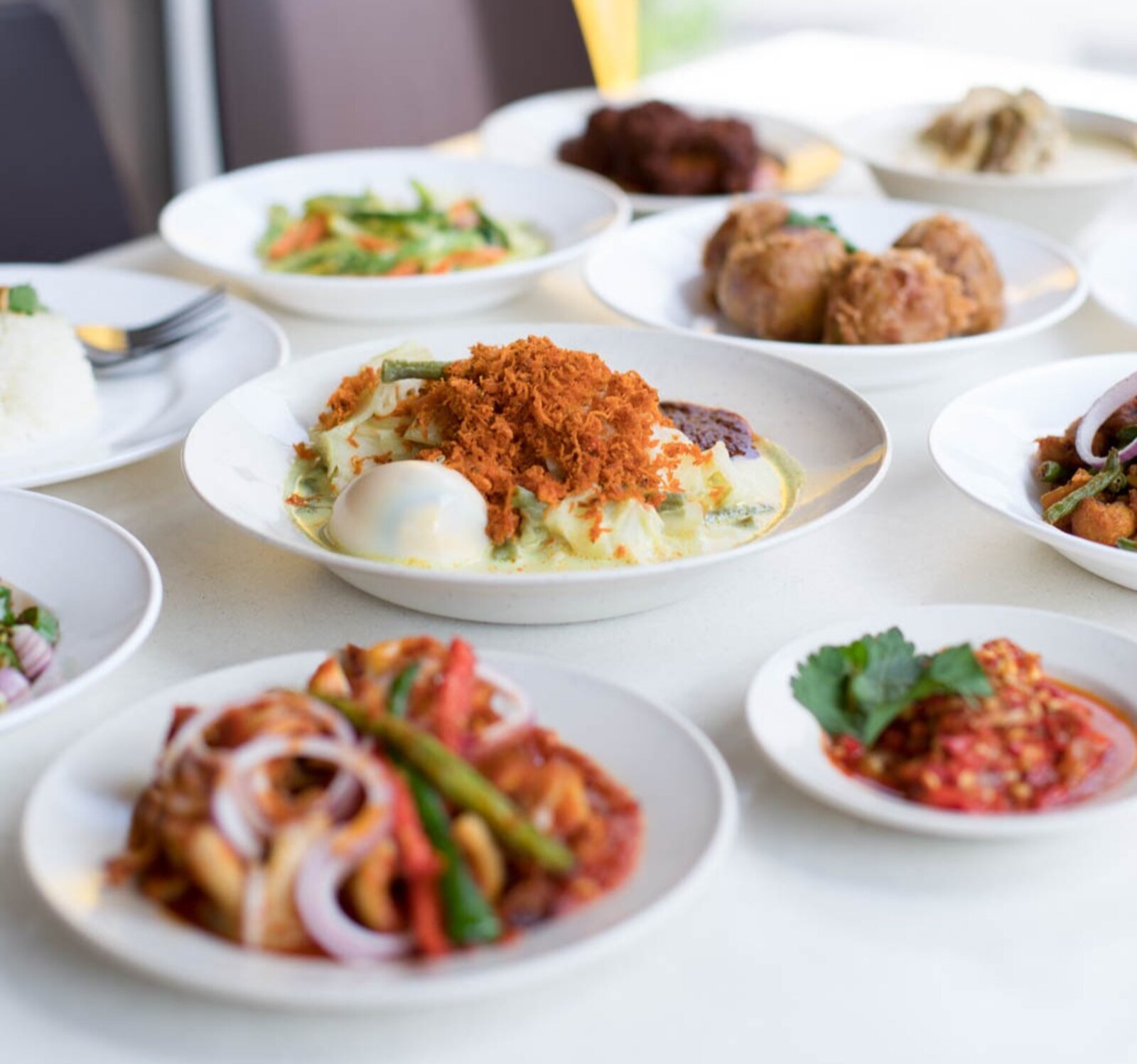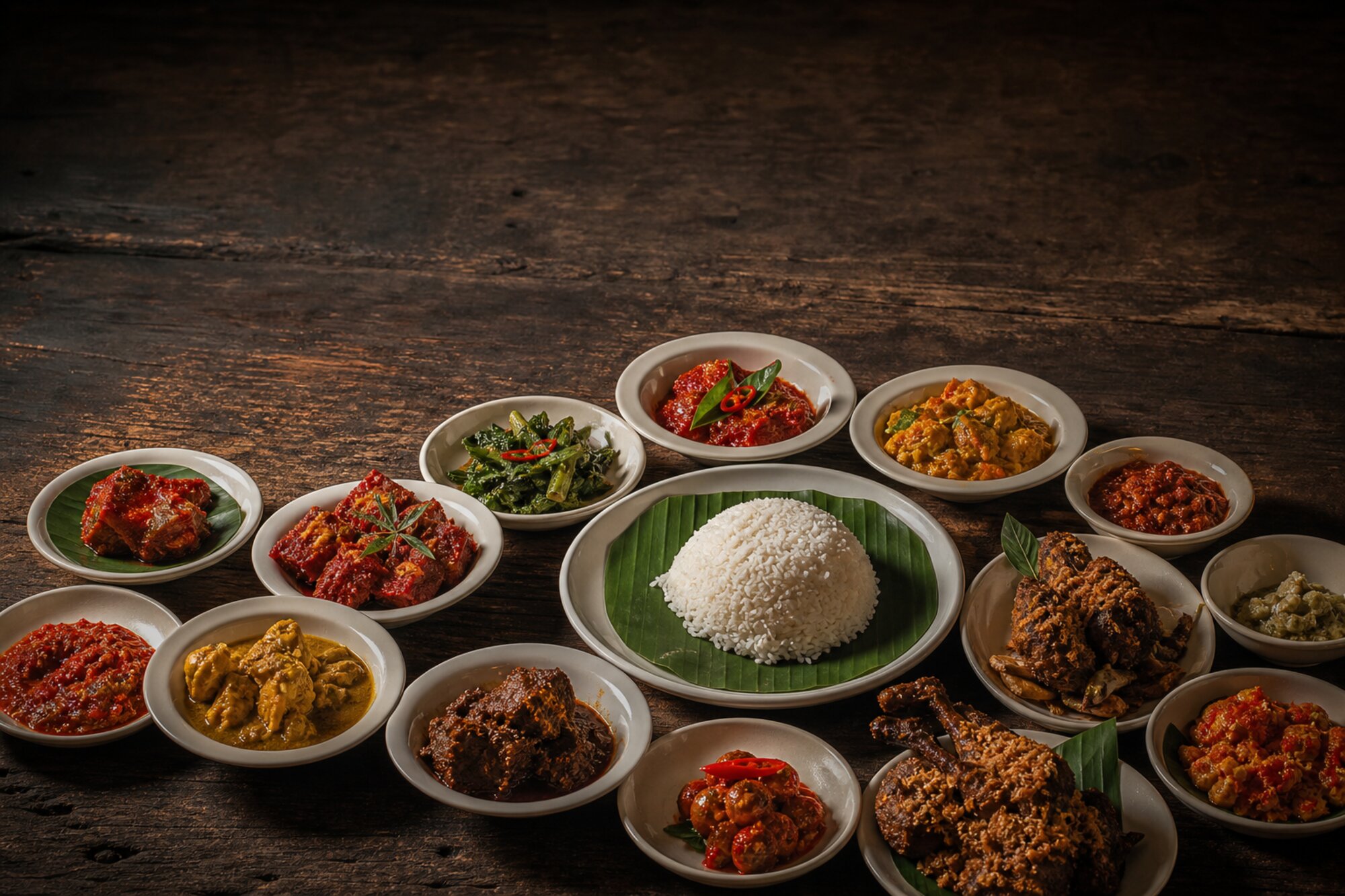
Where nasi padang comes from
Padang is the capital of West Sumatra in Indonesia, and the food is Minangkabau cooking. Minang cooks are known for slow cooking with coconut milk, chilli, ginger, galangal, turmeric and lemongrass. Many dishes are cooked down for a long time, which is part of why they hold well on a counter through the day.
The Minangkabau also have a long tradition of merantau, leaving home to make a living elsewhere, and that is how the food travelled around the region. Our own story starts that way. In the 1920s, Haji Marlian Athar and Hajjah Rosmah Mailu came to Singapore and sold nasi padang from a push cart in Kampong Glam. A sailor friend painted their signboard, "Sabar Menanti", which means "wait patiently". You can read the rest on our story page.
How ordering at the counter works
There is no menu to memorise. The dishes are laid out behind glass, already cooked, and you simply point at what looks good. The server puts rice on your plate, adds each dish you choose and usually spoons some gravy over the rice.
It feels fast the first time, so it helps to know the rhythm before you reach the front of the queue.
At Sabar Menanti the counter is freshly cooked and the spread changes daily, so the dishes you see on one visit may not all be there on the next. If there is something particular you want to try, just ask the server what is on today. It is a normal question and we are happy to explain any dish you do not recognise.
- Look over the whole counter first, so you are not deciding at the glass.
- Choose two or three dishes for a first plate: one meat or fish, one vegetable, maybe an egg.
- Ask for gravy over your rice if you like it wet. Say so if you prefer it dry.
- Tell the server if you want to go easy on the chilli. The sambals are the hottest part.
- Your plate is priced by what is on it, so ask if you want to know the total before paying.
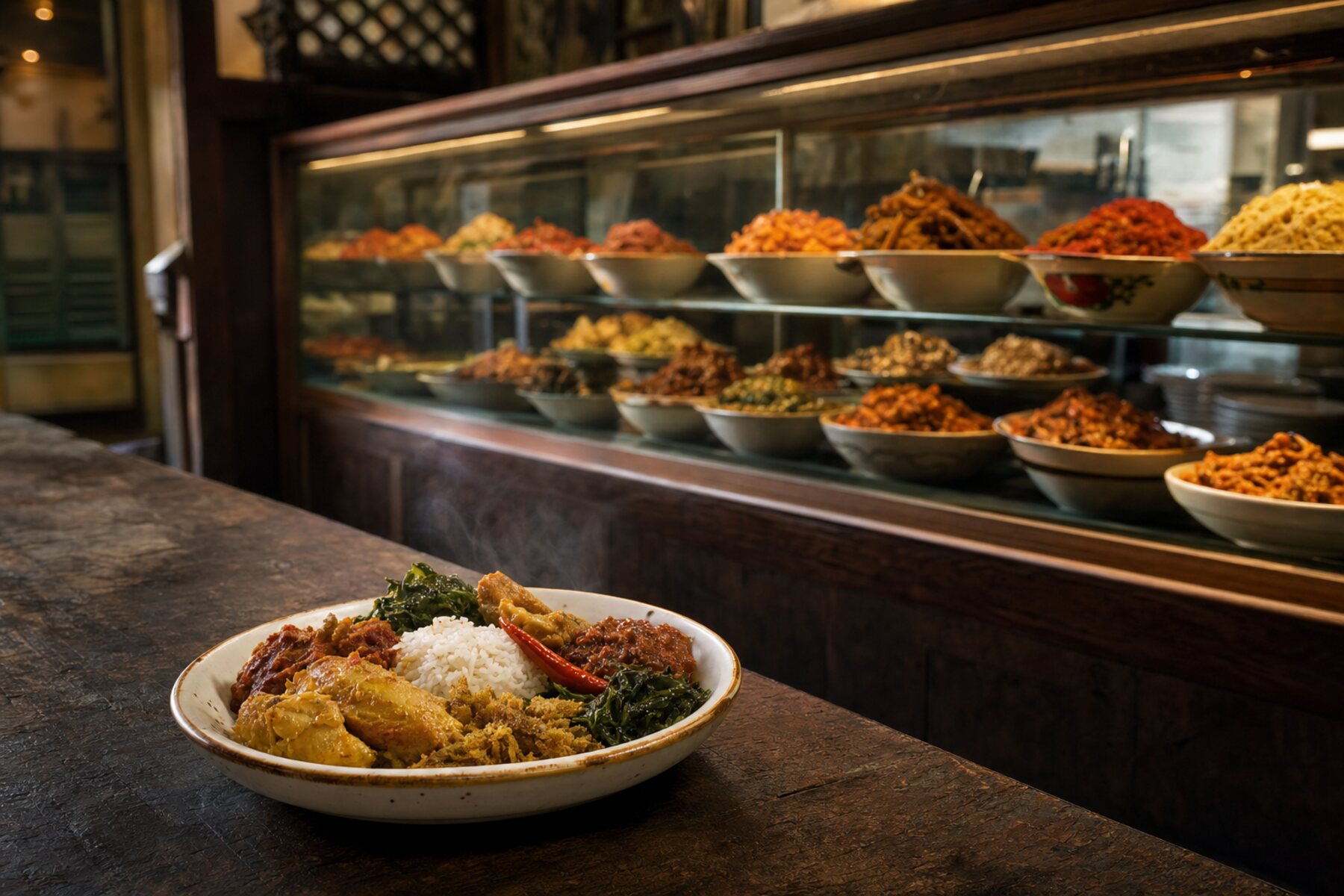
What to put on your first plate
Our counter changes daily with what the kitchen is cooking, but these are the favourites most first-timers start with. You will find them on our menu page.
- Beef Rendang: slow-cooked for hours in coconut and spice until dark, tender and deep.
- Ayam Kalio: chicken braised slowly in a rich, spiced coconut gravy, a Minang favourite.
- Ikan Bakar: turmeric-marinated fish, grilled and glazed with sambal.
- Telur Balado: boiled eggs blanketed in bright, smoky red chilli.
- Sambal Goreng: tempeh, tofu and long beans tossed in a glossy chilli sambal.
- Sayur Lodeh: a gentle yellow coconut curry of garden vegetables, good for cooling the plate down.

Eating it the Padang way
Many regulars eat with their right hand, mixing a little rice with gravy and a piece of each dish. A spoon and fork is completely fine too, and nobody at the counter will mind which you choose.
Take your time. The dishes are rich and the chilli builds, so a mouthful of lodeh or plain rice between bites of rendang and sambal helps. If you still have room, look out for kuih and local drinks, which one of our Google reviewers, Erni M. Kasim, mentioned alongside "a good variety of dishes".
Trying it in Kampong Glam
Sabar Menanti is at 719 North Bridge Road, Singapore 198687, a few steps from the Sultan Mosque and about a 5 minute walk from Bugis MRT. We are open Tuesday to Sunday, 7:00am to 5:00pm, and closed on Mondays. You can dine in or take away. Directions and the enquiry form are on our visit page.
If you are visiting as a tourist, an early start works well. The counter is full from 7:00am, the street is quieter, and afterwards you can walk on to Arab Street, Bussorah Street and Haji Lane. One guest staying at a nearby hotel, Nike Clooner, wrote: "Breakfast as early as 7am? You won't be disappointed."
The area gets busier around midday prayers on Fridays, when the Sultan Mosque fills up, so plan a little extra time then.